

KUALA LUMPUR (Nov 17): A licence will be required to export, re-export, or transfer advanced semiconductors to Malaysia, Singapore, Indonesia, Thailand, or Brazil, according to the US Department of Commerce.
Effective immediately, the US' new rules aim to prevent certain foreign actors from using advanced, US technology-based computing power to undermine US national security and foreign policy interests.
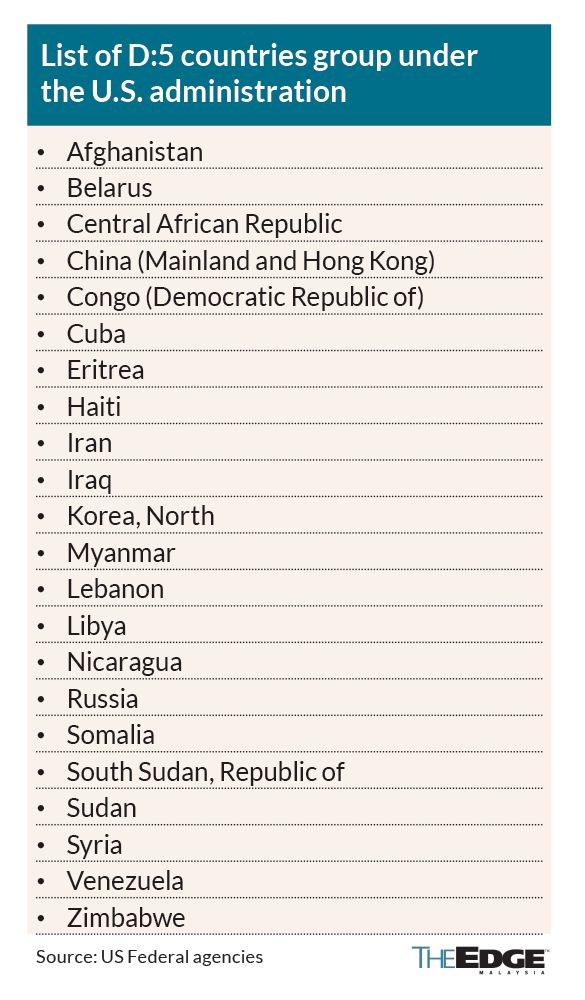
Data centres, foreign foundries, and chip exporters are required to perform robust due diligence on their customers, including any direct or indirect ownership or control by persons in US-embargoed destinations, categorised under Group D:5, or Macau.
Country Group D:5 comprises U.S. arms-embargoed destinations—some subject to embargoes aligned with UN sanctions, others designated unilaterally under U.S. policy.
The department said the licence requirement will not apply to commercial recommender systems, such as those used by online retailers or social media companies, as these functions do not pose the same national security threat.
"The licence requirement for these five countries will not apply to semiconductors destined to companies headquartered in, or whose ultimate parent company is headquartered in, the United States, provided certain reporting requirements are met."
"Commerce will be actively monitoring for countries that tolerate evasion of this IFR (interim final rule) and will consider a range of consequences for such countries," The US Department of Commerce said in a statement on Monday.
This development comes amid recent regulatory scrutiny over chip supply chains.
Malaysian authorities, including the Ministry of Investment, Trade and Industry (Miti) and the police, have been investigating Speedmatrix Sdn Bhd — a tenant at local data centres linked to Singapore-based Megaspeed — over US allegations of illicit procurement and potential re-export or diversion of advanced Nvidia artificial intelligence (AI) chips to China.
The IFR tightens the presumptions front-end fabricators and chip packagers face when exporting advanced-node logic chips, narrowing the routes to overcome them for designers based in destinations subject to 'super intelligence' (SI) chip licensing. SI is a term for AI used by the Trump administration.
"This change gives the US government critical oversight over companies headquartered in certain countries that seek to leverage advanced semiconductor production capabilities in third countries."
The IFR formally rescinds the Biden-era AI diffusion rule, which was never enforced, formalising the rescission that the US Bureau of Industry and Security announced in May 2025, said the regulator.